All seven signatories of the 1916 Declaration of the Irish Republic and leaders of the 1916 Easter Rising were executed over a few weeks at the same place: Kilmainham Gaol. This was the site of today’s tour. In the past week, we have done two walking tours, two building tours, a tour of a famine ship, and gone to two different museums, all of which have connections to what we’ve been learning in class, but nowhere have I felt more immersed in the material than at Kilmainham Gaol. The walls leak Irish history from famine to emmigration to rebellion. The final resting place of the revolution, this place was dark and poignant. Walking through the halls and seeing the cells that housed these revolutionaries was surreal.
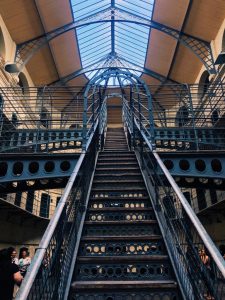
While it may be most famous for its political prisoners, Kilmainham Gaol mostly held average criminals. In fact, 90% of all prisoners who went through the jail were non-political. Originally built in 1796 as reform jail under the motto “separation, silence, supervision,” the intention was that each prisoner would have their own cell and be constantly supervised and kept quiet. However, this didn’t last long as soon overcrowding made this goal impossible. By 1850, during the peak of the famine, there could be up to five prisoners in each cell, many of whom were women and children. These conditions were horrendous, but many of the prisoners would have said that life in the prison was often better than what awaited them on the outside.
In our first class meeting, we watched the movie Michael Collins. Within the first twenty minutes, the deaths of Patrick Pearse, Thomas MacDonagh, Tom Clarke, and James Connolly at Kilmainham Gaol are depicted in a scene that was actually filmed at the jail. We saw this spot in person. On the tour, we were first shown the landing where these revolutionaries were held as they awaited their deaths. Each cell was adorned with the name of the man that was kept there. On this landing, pictured how it must have been back then and felt the desperation they must have felt as they awaited their deaths in these cells. The last stop on the tour was the Stonebreakers Yard.
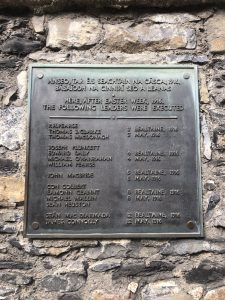
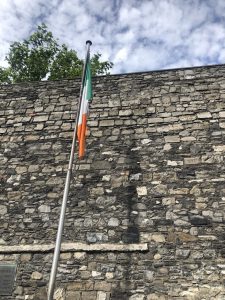
This small courtyard was the place where 14 men were executed for their role in the 1916 Easter Rising. While I was standing in the location of such a devastating blow to the movement for Irish independence, I couldn’t help but feel the gravity of what had happened there. On Easter Monday 1916, Irish Republican rebels seized key sites around Dublin, the most important being the General Post Office, or the GPO. After six days of fighting, the separatists surrendered to British forces and the leaders were arrested and eventually brought to Kilmainham Gaol to face execution. These men had risked their lives for their cause and now would surely die for it. They were brought in one by one over the course of a few weeks and executed by firing squad. Their bodies were never returned to their loved ones for burial and instead were buried in a mass grave at a cemetery down the road. Now, the courtyard serves as a memorial to these men. A plaque on the wall lists their names and two black crosses mark the exact spots where they died. Finally, a flagpole flies the tricolor: the flag that these men died fighting for.