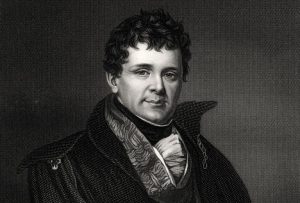
 In class we read a speech called Justice for Ireland given by Daniel O’Connell in 1836. The speech posed a question on whether the Irish would fight for justice to their country or continue the injustice that had already been done to it. If the people would continue to hope that Ireland would one day be held in the same regard as England and Scotland, or if they would give up that hope. O’Connell claims that he is a friend of the country, as well as its servant, and a stave. He does not want money or power, he only wants justice. He ends the speech with a very powerful statement; “I demand, I respectfully insist: on equal justice for Ireland, on the same principle by which it had been administered to Scotland and England. I will not take less, refuse me that if you can” (Justice, O’Connell).
After reading and discussing the speech, I did not think much of Daniel O’Connell. Again, all I knew was that he was a very important Irish political figure on the Parliament. However, when I attended the 1816 Rebellion Walking Tour, his name came up again and this time it peaked my interest. We walked to O’Connell street and I had to ask if it was named after Daniel. The tour guide, Larkin, laughed and pointed to a large statue telling me it was all dedicated to Daniel O’Connell.
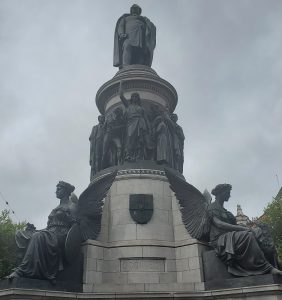
The statue was gorgeous, featuring O’Connell on top and below him four angles on the corners of the statue. Between the angles and O’Connell was a layer of other citizens including a bishop, men, women, and children. The four angels were built to represent virtues attributed to O’Connell: courage, eloquence, patriotism, and loyalty. I studied the statue and realized that it had been broken. The sword of patriotism was broken at the base, so I asked Larkin why this was. Larkin began to point out the bullet holes scattered throughout the statue and then explained that the Ulster Volunteer Force (UVF) had planned to blow up the statue. At one point they had placed a small explosive in the back of the statue, expecting to destroy the whole monument. Instead it caused a relatively small amount of damage. We do not know how the sword of patriotism broke, but it would make sense for the damage to be due to the UVF.
After reading the speech and seeing the monument of Daniel O’Connell, I became curious on what he did to fight for Ireland’s emancipation. He had been referred to as the Liberator of Ireland and once King George IV called him the King of Ireland. O’Connell led the movement to force the British to pass the Catholic Emancipation act, which was a huge step in improving the treatment of the Irish. After this he ran for Parliament where at first he could not be seated, but in 1829 he become a member of the House of Commons after a reform. Throughout his time seated in the Parliament, O’Connell managed to persuade the enactment of many reforms and overall greatly improve the treatment of the Irish.
Citations:
O’Connell, Daniel. “Justice for Ireland.” 1836.