When most people think of archaeology, they think about the excavation of dinosaur fossils to study them. However, archaeology applies to a lot more things than just fossils. Archaeology is the search and study of buried ancient objects to gain an understanding of the past. In the National Museum of Archaeology in Dublin, Ireland, visitors can gain an understanding of human civilizations in Dublin from around 1000 years in the past. While most of the other students were interested in the bog bodies, which are dead bodies that were preserved in the bottom of a bog, I found the history of the vikings in Ireland and their interactions with the Irish population to be a lot more fascinating.
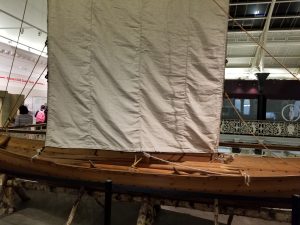
When I hear about vikings, I would think about a barbaric society of invaders that travel the seas to raid other civilizations. However, the National Museum of Archaeology showed me that the vikings might be more sophisticated than I previously thought. While the Irish civilization around 1000 years ago focused on agriculture, the vikings traveled the seas and traded with many different civilizations. Before the vikings arrived to Ireland the Irish farmers didn’t even have any formal currency, but they traded by using cattle. However, the arrival of the vikings to Ireland brought silver as a form of currency in Ireland. The value of the silver coins used in trade was determined by the amount of silver in each coin.
The vikings also helped the Irish by introducing them to better weapons. For example, the vikings introduced battleaxes to Ireland. Before the vikings arrived, the Irish have only ever used axes as a tool for cutting wood. The vikings changed this by introducing axes that were smaller in size, which allows a warrior to more easily carry and swing the battleaxe. While the viking battleaxes weren’t considered to be as valuable as swords, they were useful because they were more easy to obtain. Also, the vikings introduced better swords to Ireland.
An interesting fact that I learned from the museum was that Dublin was one of the major viking cities. The fact that a major viking city would become the capital of the Republic of Ireland demonstrates that the vikings were a fundamental part of Ireland’s history.
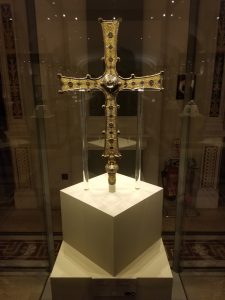
The vikings left a huge mark in Ireland, especially in early Christian artifacts that incorporate the viking art style. Some early Christian artifacts that feature the viking art style include the Clonmacnoise Crozier, the Shrine of the Cathach, and the Cross of Cong. The artifact that interested me the most was the Cross of Cong because it was supposed to contain a fragment of the True Cross.
Even though my blog post primarily focuses on the vikings in Ireland, the National Museum of Archaeology also features many other exhibitions that might interest different visitors. For example, a huge portion of the class was fascinated by the bog bodies exhibition. I think the museum might also feature exhibitions on Prehistoric Ireland and Medieval Ireland, along with many other exhibitions. I would definitely recommend a visit to the National Museum of Archaeology to anyone that is traveling to Dublin because it gives its visitors a better understanding of Irish history.