The people of Ireland know no shortage of what it is like to live under a crown that is unwelcome in their country. Having been through several major failed rebellions, the Irish continue to resist British rule and fight for a united Ireland.
One of the most intense oppressions from the British to the Irish was during the potato famine. In 1846, the potato famine hit Ireland as an unstoppable force. Although other countries were experiencing the famine, no one died like the people of Ireland. Because the British had control over what comes in and out of the country, the people of Ireland waited, while many of them died of fever, hunger, and the cold, for the British to supply some sort of substance to help feed them. Instead of helping their people, the British sent the usable crops over to England to feed themselves before helping the Irish. During the famine, over one million Irish people perished from lack of food, shelter, and support from those in charge. This fiercely intensified the relationship between the people of Ireland and the British crown.
Our Rebels and Revolutions class had the opportunity of going on a rebel tour around Dublin lead by an exuberant Irish patriot named Lorcan Collins. Oddly enough,he shares the last name of one of the most well known Irish revolutionaries, Michael Collins. Michael Collins is famous for his work as Director of Intelligence for the Irish Republican Army (IRA) as well as his diplomatic position in the Anglo-Irish Treaty which granted the Republic of Ireland a free state. He began the tour in the center of Trinity college and told us the tales of the events that start this blog. Our tour guide liked to reference to the Irish writer Wolfe Tone which was very helpful because we studied his work in class. Wolfe Tone was famous for his intense writings for a united Ireland and our tour guide idealized him for his beliefs.
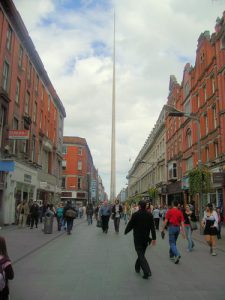
One of the first sites we saw was the Dublin Spire; a tall, narrow structure that looked like it pierced the sky. The Spire marks the ground for Nelson’s Pillar. The Pillar was built in 1808 by the British as a symbol for the Irish to remind them of all of their defeats. In 1966, a couple members of the Irish Republican Army placed an explosive at the base of the pillar not only destroying the pillar but property around it.
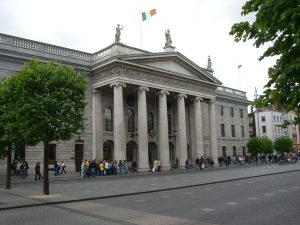
The biggest landmark of the tour was the General Post Office where the 1916 uprising leaders barcaded and raised the Irish flag. Between the towering six pillars is where Patrick Pearse read the Declaration of the Irish Republic. It is a massive concrete building that still stands as one of the oldest postal service operations in the world. Lorcan explained that the rebels cleared the building and barricaded themselves in and smashed out all of the windows incase of any explosions. The building was almost destroyed by a fire caused by the uprising and artillery destruction is still visible on the exterior of the walls. The rebels were forced to surrender and the leaders were executed shortly after.
Dublin has come a long way from being British territory to the free state it is today. Every act of resistance and revolt has not gone by without being condemned heroic. The stories of these revolutionaries will continue to be told throughout the streets of Dublin for years to come.