Twenty-one years since the peace agreement on Good Friday, our class of Rebel and Revolution abroad students witnessed a handshake between a former IRA member and a former Unionist officer at the border of the two divided communities. After spending some time in Dublin learning about Irish history and its early revolutions, our class headed to Belfast to learn about the most recent and most well known of the revolutions against the British: The Troubles. The Belfast walking tour consisted of a two part tour, one on each side of the political divide. Our first guide was a former IRA and Sinn Fein member who got involved in the troubles when he was 18 and arrested and imprisoned for four years for possession of firebombs. The other half of the tour was led by a former Unionist officer who worked under the crown most of his life.
Northern Ireland, still living under British rule, is heavily politically divided between the Irish Nationalist and the British Unionists. Before we left for Ireland we read a book titled Say Nothing by Patrick Radden Keefe that brought to life the history and emotional tear that the Troubles brought to Northern Ireland. As a class, we were all very excited for this tour because this topic was the most familiar and most recent out of the things we have studied up to this point.
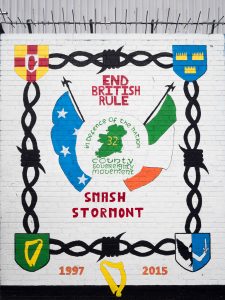
The first part of the tour started in the time frame of the 1960’s, when The Troubles started to gain momentum, all the way to the present day. The beginning of the revolution was not intended to be violent for the reason that the peaceful Civil Rights movement in America was catching so much momentum. Unfortunately, in 1966 the Ulster Volunteer Force (UVF), a group of heavily armed Protestants took charge against the Irish Republican Army (IRA), a group of Catholics who were a peaceful group at the time. These acts of violence were then counteracted by the IRA which then in turn started the war for a united Ireland. The guide said that the IRA always enforced the phrase “learn from the past” which became prominent once Patrick Rooney, the first child died in the line of crossfire was killed in a senseless act of violence. They believed that if the British would just leave them alone, innocent people wouldn’t have to suffer. One thing that stood out to me was a long wall along side of the highway that was covered in murals propagating for a united world and peace. One of the last stops was a cemetery where fallen IRA heros were memorialized. Our guides own brother had a plaque there because he was killed by a group of Protestants years after he quit the IRA. We got to see first hand just how deep the wounds go in Northern Ireland from this war.
After a bathroom break, it was time to walk to the other side of the border to the Unionists. There the two guides shook hands in a peaceful handoff. No foul language or violence was used, but just respect for the oth
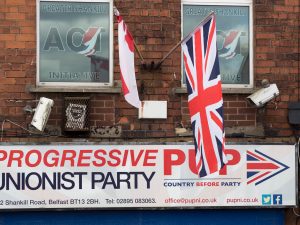
er’s humanity. It was interesting to see the view that on one side the IRA is considered heroic but just a mere couple of feet over they are considered terrorists. This part of the tour began with walking along the peace wall. This was the wall that bordered the two sides that has accumulated thousands of writings from all kinds of people with peaceful and enduring messages. Everywhere you looked were Union Jacks hanging from lamp posts, windows, gardens, and buildings. It was a drastic change in mood from the other side of the gate. Our Unionist tour guide began the tour starting all the way back to 1649, when the British first conquered Ireland, claiming it part of the crown. The tour was mostly comomerated to pro British military murals and anti-IRA propaganda.
A conflict that tore a country apart and lasted for decades and possibly decades to come was shown to us in the most genuine and realistic way it could be. Both sides were told through their own political point of view but also through their personal experiences and stories.