One of the most exciting parts of Europe is all of the historic architecture. Wherever one goes there are usually gothic Cathedrals with spires scraping the heavens, ornate renaissance and victorian buildings, and ancient castles that were once filled with nobility and were the height of society. On our trip we had the pleasure of visiting Carrickfergus Castle, a castle built in 1177 by a man named John de Courcy. Later it was taken by another man named Hugh de Lacy who expanded the building. The castle was initially built on a small peninsula for the sake of defense, and was equipped with its own harbor. It was also the center of the local community and was a big honor if one was invited into it. It contained a chapel for the nobility, but still had close relations with St. Nicholas, the local church. Eventually Hugh was overthrown by the English because he was acting too much like a king, and the placed the English inside of it. The castle began used primarily by military and saw use in the napoleonic wars and the first world war. Most notably, it was seized by King William of Orange, and it became the first place that he stepped foot in Ireland. This was a major stepping stone as it was a vessel to help the Protestant William of Orange defeat the Catholic King James and help set up the Protestant Ascendancy which would later. During the Napoleonic wars, the castle was set up as a prison for prisoners of war. There were 3 prison chambers, each able to house a large number of people. The were dark, damp, and probably looked after pretty poorly. The group was able to hang out in there and even see what was supposedly a time machine!
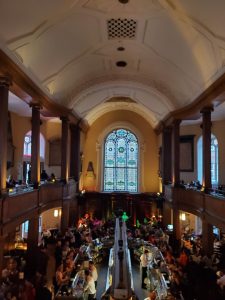
When I read the schedule for Ireland, I did not expect “The Church” to be what it was. I expected it to be a local Anglican church that was nice enough to provide us with a nice meal prior to our stay in Dublin. When I actually walked into the building, I was greeted by the sight of a beautiful old church. There was a fully functioning organ, plenty of stained glass, and a number of historic plaques around the wall. It was really an exciting experience as the 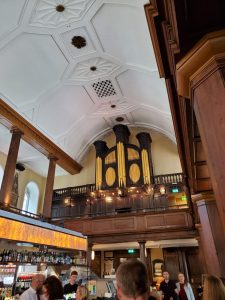 church itself was pretty much intact, but just functioning as a restaurant.
The Church, originally St. Mary’s, seemed to have been originally Catholic, and then Church of Ireland, and potentially methodist as John Wesley apparently gave a sermon there. It was also home to a number of important events for famous Irish individuals. Arthur Guinness was married there, Theobald Wolf Tone was baptized there, and Johnathan Swift attended services there. According to The Church’s website, St. Mary’s closed in 1964, but because of its historical value, it was purchased by John Keating, turned into a bar, and reopened in 2005. Now it serves a number of Irish foods, and in my opinion, it is absolutely delicious.
In regards to the food, I got prosciutto wrapped goat cheese with pickled apples, and beetroot powder as a starter, lamb pie as a main, and creme brûlée as a dessert. The food was very impressive, the combination of the sweet beetroot and salty cheese and prosciutto tasted amazing, the vegetable and potatoes with the pie hit the spot, and the creme brûlée was to die for. Not only that, but I got to try Jesse’s bailey’s cheesecake, and I was inspired to try and make some on my own (there ought to be some way I can substitute the bailey’s in the US). In addition to great food, we also got to watch traditional Irish dancing and listen to live music, which was absolutely beautiful.
The restaurant was a beautiful place to go and chat, we talked about the architecture and I got to know Jesse a bit. She definitely seemed like an interesting person. We also discussed one of the most notable topics of the trip: beaning. If you don’t know what that is, you probably read about it from someone else, it is just making baked beans and dumping them in front of someone’s door as a prank. We also read about the history of the church and talked about the economic benefits and downsides of living in Dublin. I was also recommended to try Heineken 0.0, and non-alcoholic beer which allowed me to enjoy my time at pubs without drinking more than I should.
If I were to return to Dublin, this would be one of the first places I would return. It really made me excited for what was to come as it was already far nicer than I was expecting. It wouldn’t be the only church building I went to, but it was definitely the most unique and I hope it remains on the schedule for future groups to enjoy.