The actions of the Vikings have had a profound influence on the current state of Irish political affairs. The Vikings were fierce and effective warriors who lived between the late 8th and 11th century and were known for pillaging trading posts in Northern Europe and for their advanced navigation technology and skill. Because of the distance that they traveled and the vast number of locations that they pillaged, stories and myths of the Vikings have been passed down generation to generation, shaping the Irish cultural identity. This can be seen through the stories that our tour guide of the Viking and Norman tour told us. He spoke about the Viking Strongbow and his importance in Irish history. The Christ Church tour guide also spoke of Strongbow and how many believe that his body was actually buried in the church and because Strongbow was known for being a dealmaker, many would shake hands across the coffin of Strongbow in order to solidify an agreement, a more intense version of pinky swearing if you will. Many also confirmed a deal by striking the agreed upon transaction against the coffin of Strongbow. Strongbow’s coffin sustained a great degree of damage from the large number of objects that were struck against the coffin and was eventually taken away from the public and put on display to preserve the coffin. However, according to our Christ Church tour guide, Strongbow was never actually buried in the coffin, instead a Spanish soldier lays in the tomb.
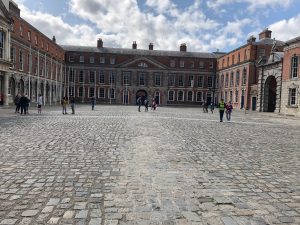
After the construction of castles in Northern Europe, to protect their resources and people from external threats like the Vikings, the Dublin Castle served as a protective shield for the monarchy and in extension the crown jewels. The existence of the symbolic Castle played a prominent role in the end of the struggle for Irish independence that resulted in the Republic of Ireland. As can be seen in a prominent scene at the end of the iconic movie Michael Collins starring Liam Neeson, the Irish military is depicted standing alongside the British military within the castle grounds as the British flag is ceremoniously brought down and the Irish flag is raised. This signaled the establishment of a free Irish republic. Although Collins was able to negotiate with the British and establish a free Irish nation, he was not able to gain all of Ireland under the Anglo-Irish Treaty. This lead to the creation of Ireland and Northern Ireland, where Northern Ireland remained under the control of Britain. However, because there were many people in the North that wanted to be independent from Britain and be united with the Republic of Ireland, groups that sympathized with this ideal, most prominently the IRA, rose up and lead a violent campaign consisting of bombings and assassinations in Northern Ireland during the late 20th century. The violence between the IRA and the Ulster Unionists tore apart Northern
Ireland, ripping apart families and communities, leading to the time period being commonly referred to as the Troubles. However in this current political landscape, it will be interesting to see what happens in Northern Ireland because Prime Minister Boris Johnson has publicly stated that he plans to have Brexit implemented by October 31st. Northern Ireland is currently under the control of Britain and if Brexit is passed by Parliament, there will no longer be open borders between Britain and its neighboring countries, including Northern Ireland. There has even been discussion surrounding the possibility that a hard wall would be rebuilt to separate Ireland and Northern Ireland. If this happens, tensions will flare and most likely will reignite the issues of the Troubles. However, there is a clause in the Good Friday Agreement which led to a cease fire between the IRA and the British government which stated that Northern Ireland had the ability to vote to join Ireland and leave Britain. A border poll was held in 1973 on the topic of whether Northern Ireland should join the Republic of Ireland, however the poll was boycotted by Irish nationalists. The poll had a voter turnout of 58.7 percent and 98.9 percent of the people who voted, voted to stay in the United Kingdom. Although there has been a referendum in the past in favor of joining Ireland that was unsuccessful, it will be interesting to see what Northern Ireland decides to do in the coming months.