If you are a lover of history or the natural world, you know there are certain things–metonymies–almost, that define a place. When I think of the Great Pyramids, I am blown into the desertous sands of Egypt, and when I imagine visiting Machu Picchu, I find myself scaling the harsh, green Andes in Peru. When I think of the Bog Bodies, a vast, flat, green landscape of damp earth and water covering the Irish Isle comes to mind.
It is at the National Museum of Archeology in downtown Dublin that one can find these Bog Bodies. For those unfamiliar, Bog Bodies earn their fame for being incredibly old (from up to 400 BC) well-preserved human remains. These people suffered gruesome, violent deaths, many for the purpose of ritual sacrifice and were then deliberately placed in the bogs across Ireland. The remains are found in such preserved condition due to the low temperature and oxygen levels found beneath the peat (Colm, 2011).
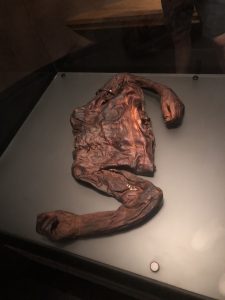
As a class, we visited this museum with the purpose of learning more about the overall history of Ireland from an archaeological perspective. Seeing and learning about the Bog Bodies and the complex nature of ritual and sacrifice in this country’s history was fascinating and worth the trip, but unfortunately for me, the rest of the museum seemed bland, outdated and lacking in creativity. Despite that, I am very glad I went because I was able to see the bodies up close, and learn a bit of their story. The exhibit is home to several bodies, or unfortunately for some of them, only parts of bodies. In the case of Oldcroghan Man, only a tor
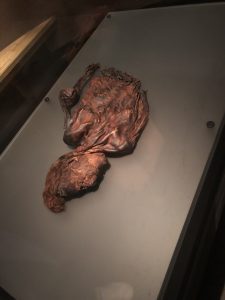
so and arms were recovered, and for Clonycavan Man, only a disfigured visage, torso and partial arms remain. The skin on the bodies has been preserved, but the color and texture have changed to give them a dark, brown, leathery look. The remains have a rather emaciated look as most of the fatty tissue and muscle are gone. What I found most striking about some of them is their bright ginger hair. Unfortunately, as I read further, I learned that this is not their natural haircolor but instead due to the body remaining in the bog for so long.
Though it is hard to tie what I learned about the Bog Bodies directly into our topic of Rebels and Revolutions for class, I do believe that their spiritual and ritual significance is important. In class and in our excursions, we almost always find that religion (now being Christianity) is either an obvious or underlying factor in conflict, culture and history. The Bog Bodies show how serious the Irish took religion upwards of 2,400 years ago at least, and this may explain why religion is still such an important part of the Irish people today. As an American, I find it hard sometimes to understand why people would take such lengths for their religious beliefs. But then again, the U.S. simply doesn’t have the same history as Ireland. So many different religions and denominations and even people who rejected religion came to the U.S. to start a new life. We pride ourselves on our freedom to practice what we want, if we want. In Ireland however, religion was much more set in stone, much earlier in time. Learning about the Bog Bodies helped me put this idea into better context, and I would recommend visiting for all who come to Dublin.
Works Cited
Colm. “Irish Bog Bodies, Some Recent Discoveries.” Irish Archaeology, 11 Aug. 2011, irisharchaeology.ie/2011/08/irish-bog-bodies-recent-discoveries/.