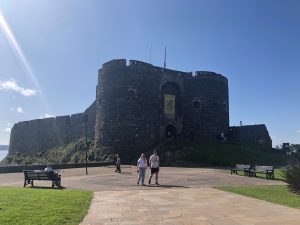
The last and most likely oldest excursion on our trip was to Carrickfergus Castle. Nestled between the sea and a small town just a twenty-minute drive from Belfast, this 12th century castle is the pride and joy of Carrickfergus and allowed our class to explore Ireland in an earlier time period than most of our classwork has been centered around, while still making connections to today.
The castle was first built over 800 years ago by John de Courcy, a Norman invader. Courcy was a younger son of an established noble family who would inherit no wealth or lands. He instead conquered parts of Ireland to make a name for himself and was quite successful. The King of England, Henry II, took note, and the two men struck a deal: all lands Courcy conquered he could keep as long as he ruled in the King’s name. All was fine and dandy until Courcy’s expenses began to outgrow his incomes. To compensate, he began to mint his own coins and it was there that he made a grave mistake (worse than the obvious economic inflation blunder that history has seen nations ranging from the Weimar Republic to Venezuela drown in): he had his own face put on the coins instead of the King’s. When the King, now King John, found out, he sent Hugh de Lacy to depose him and the 27-year reign was promptly ended. The castle fell under more direct rule of England after that.
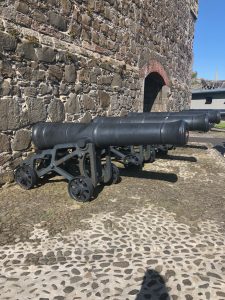
By sprinkling our tour with little fun facts about the people, practices and area, Jackie, our tour guide, did a great job of keeping us entertained and focused. She discussed several defense tactics utilized at the castle including murder holes, where they would pour anything from boiling oil to rotting animal guts and carcasses onto attackers. After taking a look at the storage cellars, she told us that in World War I, these spaces were used as a military prison holding mostly French soldiers. In World War II, they were outfitted with a stove, toilets and bunk beds for use as a bombing raid shelter. The most comical but also slightly gruesome fact was that the canons in the castle had never killed anyone on purpose. In a demonstration gone horribly wrong, four city councilmen were killed. Needless to say, the canons are no longer in functioning condition.
She also shared that, for two weeks, this castle was where King William’s army laid siege until finally landing and beginning to assemble his army a year before traveling south for the famous Battle of the Boyne. Earlier in the trip, we visited that site and learned about the significance of William’s Protestant army defeating James II’s Catholic, largely Irish army.
Carrickfergus has a population of about 28,000 individuals, 78.26% of whom identified as having a British national identity. Additionally, 80.70% of residents say that they grew up in a Protestant household. The statistics for Irish and Catholic are very similar to each other as well (NINIS, 2011). From these numbers, I see that the influence of an established British presence through the castle had a profound effect on the demography of the people living in the area. According to the Internet Archive ‘Wayback Machine,’ due to the presence of Protestant paramilitary activity in the area during The Troubles, the Catholic community often felt threatened and many ended up leaving Carrickfergus. This would explain why the percentage of Catholics has been in decline for the last fifty plus years.
Though I did enjoy Jackie as a tour guide, I was a bit disappointed that she failed to mention anything having to do with the religious conflict in the area. All that research I had to do on my own, and my interpretation of her choice not to discuss this is that there is still some uneasy feelings between the two denominations. Overall, though, this was a fun but thought provoking excursion and a good way to bring our Irish Rebels and Revolutions research to a close.
Works Cited
Donnelly, Hugh. “A Short Story of Carrickfergus Parish.” History of Parish, Wayback Machine Internet Archive, web.archive.org/web/20120215225542/http://www.carrickparish.org/history_of_parish2.htm.
“Statistics.” NINIS, 2011, www.ninis2.nisra.gov.uk/public/AreaProfileReportViewer.aspx?FromAPAddressMulipleRecords=Carrickfergus%40Exact%2Bmatch%2Bof%2Blocation%2Bname%3A%2B%40Exact%2BMatch%2BOf%2BLocation%2BName%3A%2B%2BCarrickfergus%4023%3F.