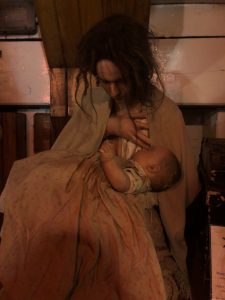
Death echoes through the cries of the children and resounds in the cacophony of mothers’ screams. Death lingers in every breath asphyxiating the ships inhabitants in its hopeless and merciless state. Yet, the ship is haunted in another way as well. One can almost hear the pleading and bargaining that went on in this cold, dark cave. The mothers pleading for heaven or hell to fill the bellies of their starving children. There is something sacred about these tragic deaths. Perhaps, it is the loss of hope. Many of these children knew little but hunger and suffering, and that, in and of itself, is a crime against the human condition.
I cannot imagine a soul on Earth that could ignore the cries of the starving children begging for food to line their empty bellies. Yet, it happened, and yet it still happens. How can we allow this?
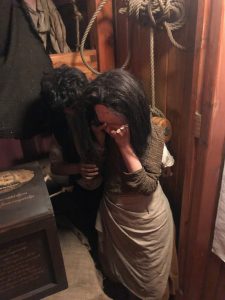
In Irish history, amongst thousands of ships carrying Irish emigrants, there is only one ship that recorded no fatalities: the Jeanie Johnston. This ship was absolutely revolutionary in its approach to emigration because a doctor was on board, individuals were guaranteed thirty minutes on deck, human waste was quickly removed, food rations were provided, and sheets were shaken daily to remove lice. These simple, low-cost measure saved thousands of lives. Unfortunately, according to the tour guide of the Jeanie Johnston, these measures also came with a price, and the vast majority of individuals did not have sufficient funds (approximately six months wages) to afford a ticket. Additionally, the majority of ships categorically refused to offer these simple amenities. Thus, the tour guide estimated approximately 150,000 people died from preventable causes.
This is mirrored in the current practice of individuals using coyotes, people who facilitate illegal immigration as guides through treacherous terrain, to immigrate to other countries. While enduring an already harrowing journey, immigrants are often subjected to repeated instances of abuse and even death by their smugglers. However, the threat of such instances is better than the looming certainty of an untimely death. According to one individual illegally fleeing the conflict in Syrian, “There were 30 people on the truck. I didn’t eat for four days because the food was dirty. I saw people die. They were pushed off the truck by the smugglers. A Somali man broke his leg when he was shoved off the truck,” (Squires 2015). It is impossible to determine the exact number of individuals who die during the illegal immigration process but current estimates place the figure at a minimum of 60,000 deaths since 2000 (International Organization for Migration).
While it may seem impossible to completely eliminate or even reduce the number of fatalities due to such instances, I assure you that is not the case. The majority of individuals fled Ireland due to a potato famine and later economic turmoil and violence. If Great Britain had stopped exporting food from Ireland while the Irish people were starving, they would not have need to flee. The same can be said for refugees fleeing Syria or even Mexico. They are searching for ways to escape severe violence and almost certain death. If these conditions were alleviated through diplomatic programs dedicated to reducing tensions between warring factions, global reconciliation efforts, and a higher dedication overall to the peace process. It is possible that the worst of the conflict could be alleviated. In Mexico, support for increased economic and social welfare programs could help individuals find work and increase the current quality of life in the more impoverished areas.
Works Cited
“Migrant Deaths and Disappearances.” Migration Data Portal, International Organization for Migration, 28 June 2019, migrationdataportal.org/themes/migrant-deaths-and-disappearances.
Squires, Nick. “The Shocking Abuse Refugees Endure at the Hands of People Smugglers in Libya.” The Telegraph, Telegraph Media Group, 23 Feb. 2015, www.telegraph.co.uk/news/worldnews/africaandindianocean/libya/11428572/The-shocking-abuse-refugees-endure-at-the-hands-of-people-smugglers-in-Libya.html.