When an American thinks of a normal life, they think of a middle-class person living in a neighborhood of middle-class people with somewhat large houses that have electricity, running water, and fair amounts of space. Modern Americans have been so accustomed to unnecessarily large houses and modern amenities that it becomes hard to believe that even 50 years ago most people lived in poverty in Dublin. People live close together with very little property and awful sanitation. One such tenement was found at 14 Henrietta Street. It is a magnificent building created in the 1700’s as a home for some of the city’s noblemen and women and acted as a display of their wealth. The building was alive with up to 100 savants, guest, and family members running around. For a period of time it was even home to a horse! The building had a number of floors, some dedicated to servants, some dedicated to bedrooms, some for living, and a few more private floors for the owners of the building.
This went on for a number of years until the Act of Union in 1800, an act that united Ireland and England into one
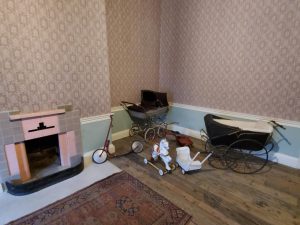
country. After this took place, Dublin’s economy began to fall and a lot of people were forced to seek living in Dublin in order to keep a decent job. At this point in time, 14 Henrietta Street was converted into a tenement building, and a lot of people started to move in. Single rooms would hold entire families. It lacked privacy, the doors were always open, and most of the areas were hardly sanitary. A lot of people didn’t have blankets, so overcoats were used to retain heat in the night. The main hallway was not lit, and the stairwell was hardly in good enough shape to be considered safe. But this is what people were used to. The grand stairwell was taken down in an effort to make more rooms, and others were divided into smaller rooms.
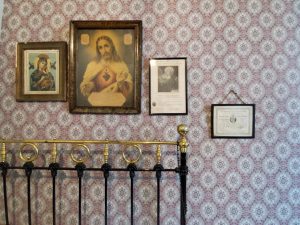
The rooms were clearly home to poor Catholic families, with many holding pictures showing the family’s participation in uniquely Catholic devotions such as the Sacred Heart, the Immaculate Conception, and Our Lady of Fatima. This goes to show the state of Irish Catholics at this period in time. It shows the poverty they were forced to live in, and gives more light to why they were willing to fight so hard for their rights. The building became less necessary when John Cooke began showing off pictures of tenement life in the mid 1900s and sparked a debate over the issue of tenements.
Eventually newer, more spacious buildings were built for the majority of those living in Dublin, and a number of people were able to finally leave the building before it formally shut down in 1979. This type of building should really show your average American how lucky they are to have to house they currently have. Even the poor in America have nicer living conditions than this. We all should be able to look at these living conditions and be grateful that we are relatively free from persecution and can live decent lives.