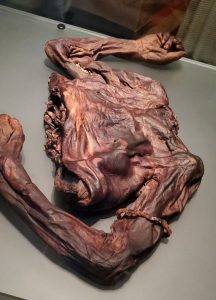
 Before leaving for Ireland our professor assigned us to read a non-fiction novel about The Troubles in Northern Ireland called Say Nothing: A True Story of Murder and Memory in Northern Ireland by Patrick Radden Keefe. Towards the end of the book when the authorities were searching for bodies of the IRA’s “the disappeared” (pg 262), it is said that the practice of disappearing people was nothing new to Ireland. The Irish landscape was covered by peat bogs with “anaerobic and acidic conditions (Keefe, 265),” properties that could preserve dead bodies. Peat cutters occasionally found human bones and sometimes entire bodies in these bogs. These cadavers dated back as far as the bronze age and often showed signs of “ritual sacrifice and violent death (Keefe, 265).”
On the first day of class these bog bodies were already brought up into discussion, because they peaked the interest of many students, including me. We learned that these bodies were on display in Dublin, Ireland at the Museum of Archeology and that we would be able to see them. The science lover in me was very excited to see the bog bodies, but at the same time I wondered about the ethics of taking someone’s body and putting it on display for hundreds of people to gawk at.
The bog bodies made a significant historical and scientific impact on the world by their discovery. At the time the first few preserved cadavers were found scientists were not sure how to continue their preservation while conducting studies on the bodies, this led to many bog bodies decaying. However, as science progressed we were able to successfully preserve some of the bog bodies and put them on display to teach more about the history of Ireland and the rest of Europe. Studying the bodies took a dedicated team of 35 – 37 specialists and a significant amount of time.
The museum had four bog bodies on display, all with plaques giving as much information on the 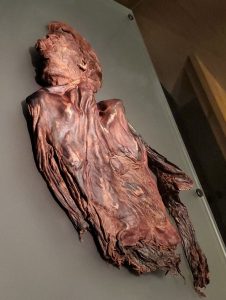 cadavers as possible. This information included the gender, height, any known facial hair, cause of death, any unusual markings or signs of ritual sacrifice, and any other information scientists discovered. For example, one bog body on display was called Oldcroghan Man who was alive during the early iron age around 362 – 175 BC. Scientists found that he was over 25 years old and about 6’3 and a half inch. It can also be reasonably guessed that he died early in the year because his diet was mainly meat, and crops would not have been readily available at that time of year. The man died from a stab to the chest and a wound on his arm suggests he attempted to defend himself. Another interesting fact was that the man’s nipples had been cut off, which was an Irish (thing), because sucking the King’s nipples was a sign of submission. This meant you must have nipples to become King. It is also assumed that the Oldcroghan man stood at a high social ranking due to the well manicured nails and hands that were not worn by physical labor.
The way Say Nothing : A True Story of Murder and Memory in Northern Ireland by Patrick Radden Keefe introduced the bog bodies, made me wonder if there were any connections between the IRA’s practice of disappearing people and Ireland’s history of disappearing people. During the time of The Troubles these bog bodies were common knowledge, and this makes me wonder if the IRA took inspiration from this technique when burying people in unmarked, hidden graves. I am also curious on why the author brought up the bog bodies at all, and if he did it to suggest a connection between the disappearings throughout history.
Citations
Keefe, Patrick R. Say Nothing: A True Story of Murder and Memory in Northern Ireland. , 2019. Doubleday.