I feel the need to start this post with explaining the fact that I was fairly uneducated about Ireland. In fact, I was so uneducated, I didn’t even realize the country was divided into the Republic of Ireland and Northern Ireland (part of the UK). As I researched the history and continued to unravel their dark and somber history, I was left with the question: why didn’t I learn any of this material in high school? The most recent tragedy, which was known as “The Troubles,” lasted approximately 30 years, and yet I hadn’t been informed on this horrible, bloody struggle. The most irritating part to me was how recent The Troubles took place, only ending in the late 1990’s. After reading the book Say Nothing, I felt more prepared to travel to Ireland with the UW Rebels and Revolution program. Now, after participating in the Belfast walking tour, I feel more knowledgeable of the history of this magnificent country.
We started our tour by talking to a former IRA (Irish Republican Army) member. The location where we began made all of us “fan girl” in a way, as the Divis Flats were a heavily mentioned apartment building in Say Nothing. Everyone had to get their 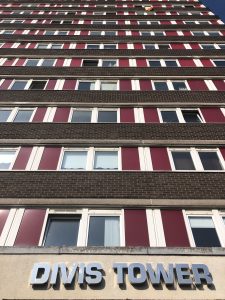 pictures to capture the exciting moment. I had to keep reminding myself that locations mentioned in the book were most likely still intact because these events took place fairly recently. The IRA member we spoke to was named Gerd Fasco, and astonishingly enough, he joined when he was under the age of 18. The British government found fire bombs in his apartment and was sentenced to eight years of his life in prison. However, he got out after six years for good behavior. Gerd, like many Irish, was and still is opposed to British rule. He believes Irish freedom and unity will solve many of the political struggles Ireland faces today.
As we continued on with the tour, I got a profound sense that Gerd was dedicated to the cause of a united Ireland. He talked with great passion about how everyone who died while fighting, was heroic to him, and to the IRA. He knew a lot of “top” members of the IRA such as Bobby Sands, who participated in a hunger strike for 52 days and was elected into parliament while in prison. His wife even worked with Gerry Adams, a very prominent man involved in The Troubles. I felt he was collected as he presented his story and confident Ireland would succeed one day. He explained how no one should need to die for Ireland anymore, but for the situation to be sorted peacefully and through a politically inclined way. Gerd was proud to fight for the IRA and felt that it was his right to unite this country. By no means would he consider the IRA a terrorist group.
However in contrast, by talking to an ex loyalist, we understood very quickly, that by all means, he would consider the IRA a terrorist group. He talked with a great sense of emotion about all the lives and friends he lost due to IRA attacks. Two family members were killed, and so were two friends, one of which had a seven year old daughter who was unfortunately killed as well. He would later tell us that the troubles were a “slaughter of the innocent” and I felt in a sense he was victimizing the protestants. I understand biases will originate from both sides, but this was a struggle between two very different groups, each whose ideas and ideals greatly differed. The reason I felt he was playing the victim was due to the fact the protestants were not the only ones facing discrimination. Protestants were actually in majority in the North of Ireland, and would frequently invade home owners who were Catholic. Many Catholic deaths occurred simply because of their religion. Therefore, I thought it was unfair to use the words he chose to express.
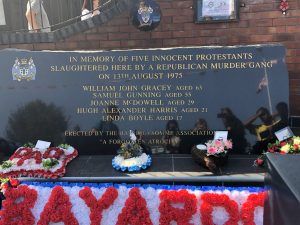
We were taken to a site that made me stand in disbelief. A mural of the shooting in Paris, done by ISIS was on the wall and underneath, the caption read, “IRA- Sinn Fein – ISIS, no difference.” Total propaganda was exhibited and it was very clearly in sight for the public eye. There were other very defiant texts and captions that exhorted anger towards the IRA and Sinn Feinn. One that stuck with me was the plaque that read, “In memory of the five innocent protestants slaughtered here by a republican murder gang.” The words used were so vulgar and intense, the biases were so clear. Gerd, would have stood proudly and asserted that these acts were heroic, while the ex loyalist would stand his ground in saying they were clearly terrorist acts. This was the true moment where I understood the profound difference between the two.
In conclusion, it still frustrates me our schooling system in the United States keeps so many recent and important historic times a secret. I felt embarrassed to know so little about a topic that affected millions of men, women, and children.