Talking about rebellions and the corresponding oppression is often difficult, but our guide Lorcan Collins somehow made it seem easy. He was open and frank about his perspective and kept reminding us along the way that his tour was incredibly influenced by the side of history he’s on. The Republican perspectives he gave on such heavy events that happened during the 1916 rebellion reflected the same sentiment that started them in the first place. It’s often easy to imagine the opinions of historical events as long past, but Lorcan served as a vibrant reminder that just because it’s been decades doesn’t mean that the strong viewpoint of the 1916 Republican revolutionaries has been erased. Realities and mechanisms of change may be different than they were, but the sentiment lives on.
One of the first things that he shared with us, clustered in a semicircle in the middle of Trinity College, was the Declaration of the Irish Republic. Pride unapologetically shone through as he explained how magnificent the document was and still is for Irish Republicans. He explained that despite the fact that it’s comparatively short and sweet in relation to other declarations of independence, and it’s undeniably poetic in its eloquence. He noted that one of the letter e’s was printed upside down. With a smirk, he referenced how some cultures purposefully make mistakes in works of art because only divinity can truly achieve perfection. By doing so he alluded to the idea that if it wasn’t for that one disoriented letter e, the document would be perfect.
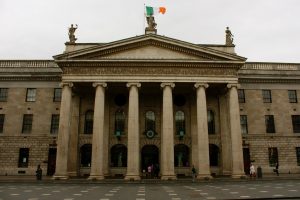
Despite the seemingly unfiltered republicanism that Lorcan displayed, he did take some time to recognize the times that the cause fell short. Namely the way that many of the leaders of the 1916 rebellion weren’t necessarily the most pro-feminist people you’d encounter. While it’s true that we are talking about the early twentieth century when not very many peoplewere open to the feminist agenda no matter where you found yourself on the globe, I appreciated the time that Lorcan took to point out the moments that he wasn’t proud of happening during the rebellion. When he spoke of how the women who were prepared to fight for what they believed in were dismissed as valid members of the armed struggle, he spoke with a tone that understood how wrong that was.
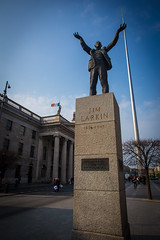
Although Lorcan continually claimed his biases with sarcastic jokes about how great he was at giving both sides of the story, he gave a well-rounded perspective on the side that he sees from. It was apparent that he knew that no matter how much he could try and glorify the revolutionaries, they had faults and the events that took place weren’t positive. It was obvious that he knew they weren’t perfect, and they shouldn’t be painted that way. Yet he was still proud to be a Republican and much of his language showed that. The multifaceted perspective that he shared with us was fitting to the topic, and the humor he used to portray it allowed such a heavy topic to be just a bit easier to talk about.