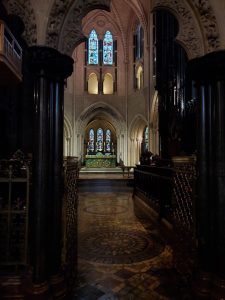
When someone visits Dublin, there is no way they could miss the Cathedral of the Most Holy Trinity, otherwise known as Christ Church Cathedral. It is the oldest functioning building in Dublin, and has been a prominent place for English Kings and Catholic Popes to visit. It is not only the secondary Anglican Cathedral in Dublin (St. Patrick’s holds slightly more prominence being the National Cathedral of Ireland), but is also the Catholic Cathedral for the Archdiocese of Dublin, despite having not held Catholic services in hundreds of years.
The church was initially founded around 1028 by the great Strongbow when he came back from Rome with a number of relics in order to start building churches. His grave had been kept there until the collapse of the southern wall in 1562, which destroyed his grave. A random Spanish crusader now rests in his place. The church is built in a Gothic style, and contains no pews as pews were not common in churches until after the Protestant reformation in the 16th century, and most churches built before the reformation that became Anlgican never had any installed. The floor consists of tiles coming mostly from the 18th century; however, a number remain from the 13th century in St. Laud’s chapel that survived the ceiling crash. Some of the tiles contain depictions of real people, with an interesting group of people shown in these tiles are the Foxy Friers, or Friers that were mendicants and threw Dublin’s economy off for a period of time.
The bell tower of the Cathedral was not only used for calling the faithful to worship, but also as a tower for defense. The stairwell upwards is laced with death traps, and is even designed in an orientation to stop enemies running up the stairs from striking with a sword. The tower was most recently used in battle by the Irish Volunteers in the Easter Rising in an attempt to set up the Irish provisional government.
The Crypt is home to a number of artifacts, ranging from liturgical items, to statues of the Kings Charles I and II, and
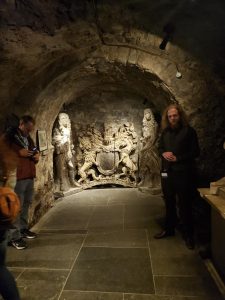
most notably to the Irish Magna Carta. The Irish Magna Carta is almost identical to the British Magna Carta. The only difference are some minor references such as London being changed to Dublin. This is the strongest connection of the Cathedral to our class content, as we not only read the document, but it guaranteed the Anglo-Normans, who built the stone Cathedral, a number of rights. These Anglo-Normans would end up marrying into Irish nobility and would support the King and thus the protestant ascendancy later on. The Cathedral would end up being taken as an Anglican church after the Anglican reformation (though this was never formally recognized by the Catholic Church), and follows their rites.
This Cathedral is more than just a beautiful building, it is a center of Irish culture and history. I believe that this Cathedral should begin to offer some of the Catholic rites occasionally. It doesn’t have to be used entirely by Catholics, but they have used the same spaces for their liturgies in the past (i.e. Choral Evensong in St. Peter’s Basilica in 2017 and Mass at the chapel at Trinity College in Dublin), so there is no real reason that the Church of Ireland should hold the proper cathedral of the archdiocese of Dublin. If people could get past emotional divisions regarding the past, maybe it could be a real symbol of progress between to Catholic and Protestant populations in Ireland.