
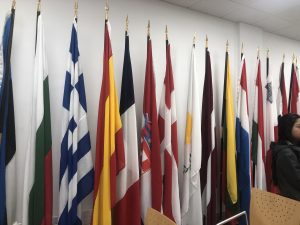
While visiting the European Commission in Dublin and talking to Economic Counselor, Willem Noë, it became particularly evident that we are the culmination of generations. We define ourselves by family, friends, political ideologies, and our nationalities. For centuries, we have defined ourselves as “American”, “English”, or “Canadian.” However, among many Europeans the label of “European” is actually beginning to supersede any specific label regarding country of origin. This trend is further exacerbated by the European Union which encourages an “ever closer union” (Noë, 8). In practice, this typically includes the intentional and unintentional demolition of barriers between countries. This is achieved through the free distribution of goods, labor, services, and capital between countries, and it eventually creates countries that, while different, have a generally European culture and feel (Noë, 9). Thus, the question is raised regarding what it means to be European in an increasingly globalized society.
While this question may seem trivial at first glance, there is actually no universal agreement regarding the boundaries of continental Europe (Noë, 6). Therefore, it is necessary to examine cultural, structural, and economical similarities that unite various countries. This is most readily apparent in the members of the European Union (EU). Currently, there are 28 members of the EU, 6 candidate countries, and 2 potential candidates (Noë, 5).The designation of candidate country implies that a country has been accepted to be European, but further negotiation regarding membership has yet to take place. On the other hand, the status of potential candidate country implies that a country may become a member one day, but that country is not currently eligible for membership generally due to instability, human and civil rights violations, or failure to meet various other standards set forth by the EU. These standards were set forth and are currently enacted by the EU In an effort to promote peace in the European theatre and increased European integration. While these goals were particularly relevant after World War II to increase German stability, they are also responsible for ensuring a long-lasting peace between various European countries through limiting the possibility of human rights abuses, strengthening trade connections, and overall maintaining an increased level of globalization and interdependence. In turn, this increases tourism and migration between the European countries. Thus, transmitting and globalizing the concept of a European culture.
The best way to conceptualize European culture for an audience from the United States of America is to realize that the EU essentially has a culture in the same manner that the United States of America has a culture. In a similar vein, each state in the United States of America has a specific culture in the same way each country in the EU has a specific culture. Thus, there is an incredible amount of variation from state to state and likewise country to country. However, there are always some commonalities such as food brands, television shows, and means of entertainment. For example, the vast majority countries in Europe have a drinking age of 18 and a comparatively strong pub culture among all age groups. In the United States, there is a general love and passion for food, particularly pizza and ice cream. The summation of these seemingly small commonalities leads to a broader and more generalizable culture. This, interestingly enough, is something that the European Commission works to accomplish for the various countries that are considered to be arguably within the European continent. This goal is admirable because it seeks to prevent war through commonality and not militaristic action.
Thus, the question of what it means to be European can be no easier answered than what it means to be American. In the same way that there is argument over if something is American or not: like Puerto Rico, speaking a language other than English, and gun control. There is argument over a country being European, which is not always related to geography. There is a heavy connotation that European means Christian. This in conjunction with geographical questions has led to questions of Turkey’s status as a European country. Therefore, it can be surmised that, while being European and a member of the EU are not synonymous. A very large portion of the European identity centers around EU membership because it stimulates economic growth, ensures civil rights, and allows for freedom of movement for citizens of all member-states.
Works Cited
Noë, Willem. The History, Political Economy & Economics of EU Integration at +/-28. European Commission.