Of all the places I have seen and visited in Ireland, I have lost my heart to the beautiful artwork and sacred emotion present in Belfast. Our venerated dead is a reflection of our values as a people. Belfast is a testament to this statement, and the scars of the past are around every corner.
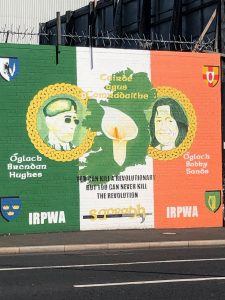
There are two very distinct neighborhoods in Belfast: the Catholic neighborhood and the Protestant neighborhood. These two groups have deep cultural, political, and ideological differences. This disconnect is so pronounced that a literal and metaphorical wall has been built to separate the two communities. The Catholic neighborhood is essentially a living monument to Irish Republican Army (IRA) and Sinn Fein revolutionaries and the idea of revolution as a whole. Large parts of buildings and walls are decorated in art glorifying the lives and times of the most recent Irish revolution. Bobby Sands and Brendon Hughes, two prominent IRA revolutionaries, feature prominently in the art and stories of revolutionaries. On the other hand, the Protestant neighborhood is a tribute to the soldiers from the United Kingdom featuring the victims of the Irish conflict and the two World Wars in equal measure. There were not key figures venerated on the Protestant side, but it is rather focused on the average soldier. This could potentially be explained by military structure and the areas that individuals heralded from.
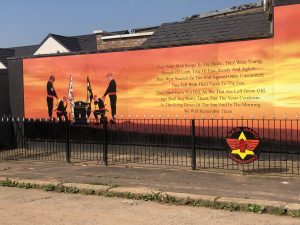
Moving from one side of the wall to the other is jarring. Within a five-minute walk, the narrative surrounding the Irish conflict completely changes. Yet, one thing remains the same: both sides are avid proponents of peace. This is inspiring to see, but it also feels slightly superficial. Children still attend primarily separate schools based on religion, and the narratives between the two sides do not hold themselves accountable for any mistakes. Until a time period is reached where objectivity and accountability are more readily available, the peace will be superficial, and any match could set it aflame.
Additionally, the overall political demographic was different between the two neighborhoods. The individuals living on the Protestant side tended to be more conservative in their overall viewpoints. This was evident through talking to our tour guides and other local individuals with strict views on unionism and patriotism. In addition, the Union Jack was prominently featured throughout the town and hung in streamers to celebrate the Battle of the Boyne (a day of celebration for protestants and mourning for Catholics). The Catholic side tended to lean more liberal, as numerous pieces of art were dedicated to other revolutions and supporting them. The tour guide and many other individuals were staunch proponents of socialism. In addition, the Irish flag was featured outside of apartment buildings, floral arrangements, and art.
There is no easy answer to achieve permanent, long-lasting peace within Belfast, and I suppose that is why I love it so much. The complexity is clear within everyday social interactions. While I was talking to a cashier, she made a joke about Protestants. Eating at a restaurant, the server mentioned the untrustworthiness of Catholics. These minute comments underline the tension still present in the underlying political culture in Belfast, and I am absolutely thrilled that I had the opportunity to analyze them.