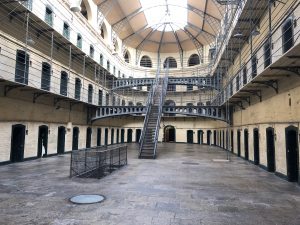
Kilmainham Gaol was created by the British to detain Irish prisoners. As well as detaining Irish criminals, Kilmainham Gaol was also used to execute many Irish revolutionaries. Many of the Irish revolutionaries that were executed in Kilmainham were from the 1916 Easter Rising rebellion. In the movie Michael Collins, there is a scene where the British government receives intelligence of where high ranking members of the Irish Republican Army are living and captures them. They are then hauled off to Kilmainham Gaol where they are beaten and eventually executed. The jail represents the fate that Irish revolutionaries would have if they were caught and despite the fact that there was a high chance that these revolutionaries could be captured or killed, they continued to fight guerrilla warfare against a large military force despite the consequences. The IRA’s success played a crucial role in the signing of the Anglo-Irish Treaty, resulting in the Republic of Ireland, free and independent of British control.
However, the jail also signified the state of Ireland during the time period that it was operational. When the jail was first created, it was intended to be a small city jail but when the city began to urbanize and expand, it became difficult for the jail to handle the increasing number of prisoners. The jail could only hold around 4,000 prisoners, however the jails capacity reached up to 9,000 prisoners during the Irish potato famine. The reason for the high number of prisoners was that Irish citizens were committing petty crimes in order to get arrested. They wanted to be arrested in order to get housing and food, and due to the circumstances of the country at that time, being arrested and imprisoned was sometimes the best option. Those who were able to gain the means necessary to leave Ireland and go to another country often did during this time despite the risks. The most common destinations

for Irish immigrants were the United States, Canada, and Argentina. The ship voyage from Ireland to the United States could take around four weeks and due to the fact that many ships did not establish many safety precautions, a large number of the passangers would die on their journey across the Atlantic Ocean. One of the main issues was that there was overcrowding on the ships, which allowed for disease to breed and spread. The issue of overcrowding also affected Kilmainham Gaol. Because of the intense overcrowding at the jail, many prisoners were shipped from the jail to Australia. As well as on the various ships that brought Irish immigrants to the United States, Kilmainham Gaol also experienced death, although these deaths were executions as opposed to disease related deaths. During the time in which Kilmainham Gaol was operational between 1799 and 1910, 140 people were executed within its walls. Almost all of the executions that took place in the jail were public, with only 11 hangings being public. Public hanging was abolished in 1868, leading to the jail adopting execution by a firing squad. The Kilmainham Gaol closed in 1924.