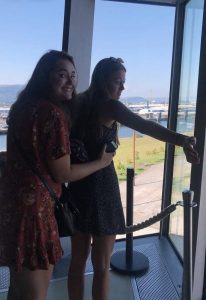
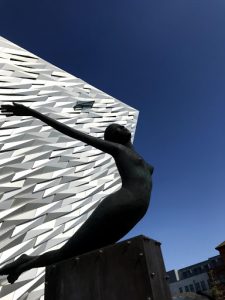
When it comes to the Titanic, almost everyone has some sort of familiarity with the iconic vessel. Whether it be from our elementary school history lessons or more recent pop culture (perhaps a movie featuring the young Leonardo De Caprio), the story of the ship invokes powerful imagery that has captured the attention of audiences for generations. It was because of this ingrained interest that I was so excited to visit Titanic Belfast. Towering over reflective pools and a nearby river, the museum itself is an explosion of modern architecture is a fairly barren landscape of Belfast. Rae Johnson, a peer and friend of mine on this trip even commented that the building, ironically, “looks like an iceberg” while others noted that the facade looked almost like a ship itself. Whether either of those architectural impressions were intended is unknown but the attraction certainly left an impression from the get-go.
Once actually inside the museum, visitors are welcomed with a comprehensive history on the construction, voyage, and tragic end of Titanic. It started all the way at the booming economy in Belfast. Belfast was originally a city of linen, actually the linen capital of the world at the time. There were over 60,000 workers in the city, but this type of work had many negative effects on the workforce including, disease and workplace injuries. The city turned from factory-based industry to the building of luxury ships, the harbour of Belfast giving the city a prime location. It was there that Harland and Wolff Co. took up business and kickstarted the shipbuilding industry for Belfast, eventually building Titanic.
What also struck me was how the story of the Titanic was overall expressed and portrayed by the museum. In general, modern culture views the Titanic as a complete tragedy. Although the end that the vessel unfortunately met was by all means tragic, the museum showed the history in a more complete and almost prideful way. The museum viewed it in a more historic and monumental manner, and less like the devastating accident that is conjured in the minds of most. It was thought-provoking to see the event in this manner.
One of my favorite parts of the entire museum was a video that showed exploration footage of the wreckage of the Titanic. It explored many different areas of the ship, and showed remaining artifacts ranging from shoes to a chamber pot. It also discussed the decaying process, explaining that rust forms in an icicle shape, which the narrators decided to call “rusticles.” The imagery was overwhelmingly invocative of what life on the vessel would have been like, and also brought an incredible realness to the disaster that occured. That caused quite a few giggles through the theater. I found this footage not only entertaining, but fascinating, especially with more recent reports that the wreckage of the Titanic is deteriorating rapidly.
I feel very lucky to have gotten to experience Titanic Belfast. It was a rare occasion in which the history comes to life in the exact location which it took place many years ago. This museum gave me a more comprehensive view of what the Titanic truly represented why it was so significant and still remains relevant today.