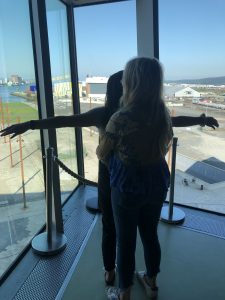
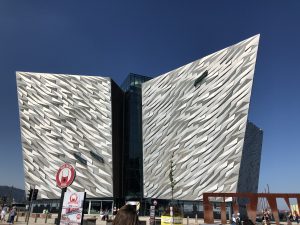
When I think of the Titanic, I think of the vivid scene of Jack and Rose standing in their famous pose, which is recognized and recreated by millions of people to this day. The iconic movie, Titanic, starring Leonardo DiCaprio and Kate Winslet has been viewed by millions and has given a brief account of the tragic event that led to hundreds of lives lost. When I set the Hollywood hit aside, I’m left knowing little to nothing about the actual history of the magnificent ship. However, that changed today as I got the experience of touring Belfast’s Titanic Museum.
The history of the Titanic actually dates back to the 18th century in Belfast. During this time, Belfast’s economy depended greatly on the production of linen and was the linen capital of the world. Approximately 65,000 people worked in these mills including men, women, and children. Sadly, the women were expected to work through pregnancies and shortly after childbirth. They were working six days a week from 6:30am to 6:00pm. Also, due to the vast amount of dust in the factories, workers commonly contracted lung diseases.
Even though workers faced brutal working conditions, the booming economy eventually lead to the production of luxury ships. Moving forward to the 19th century, harbor commissioners were able to improve the flow of the nearby river, the Lagan, and were able to expand ship building facilities. This allowed ship building to flourish on a grand scale. Harland and Wolff Co. was the most successful shipbuilding firm in the United Kingdom and the construction of the Titanic was lead by William James Viscount Pirrie. It was quite entertaining to find out that, even though he treated his workers with respect and dignity, they were terrified of him.
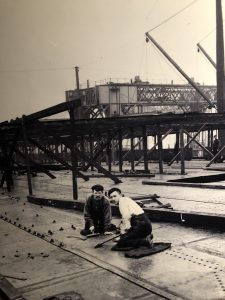
The Titanic’s construction began on March 31st, 1909. There were five main steps to build the vessel. The first part was laying the keel, the backbone of the ship, in place. The keel was made of steel plates which protect the bottom of the ship. Second, the framing of the ship was constructed and made shape of a skeleton. Third, the vessel was to be plated and riveted. Steel plates which formed watertight skin, were held in place with iron and steel rivets. This process was done in pairs, and the best pairs consisted a right hand worker and a left hand worker. Fourth, the bulkheads and decking were to be completed. This divided the hull into sixteen watertight compartments. Finally, the fitting of the rudder was the final step. There were six pieces which were bolted together. The bolts were covered in cement to protect from erosion of sea water.
Ships that were being produced during this time were of high quality. In the interior, there were individual cabins for passengers instead of a shared common room. There were also toilet facilities which I can imagine was a nice improvement from a bucket which was used by everyone. The privacy must have also been a nice change! On board, there was a radio transmission, so the captain could contact people on the mainland. He could report weather conditions and progress of the voyage. This was a great time for these civilians as coffin ships, ships that had high death rates, were long gone.
The Titanic, as millions know, devastatingly sunk in April of 1912. However, what many may not know, the company Harlan and Wolff continued to be very successful and prosperous. During the 1920’s there were more than 65,000 workers across five construction sites. World War II created a demand for naval ships to be produced and the company produced 130 large scale ships. The company proceeded to create for the world, such as in 2000 when wind turbines were produced or in 2012 when a huge restoration project was lead on an important nomadic vessel. This lead me to the conclusion that even in tragedy, manufacturing will continue, and business can still thrive.